
If you’re anything like me, when you think about early video game history, your mind likely conjures up images of old 8-bit pixelated games, joysticks, arcades, and maybe even something as “old-school” as Pong. However, beneath all that, hidden deep in gaming’s earliest history, is the story of an incredible woman named Mabel Addis, and she helped to shape the foundation for intricate storytelling in gaming, before video games even existed. When I first heard of Mabel Addis, I never expected to find one of gaming’s most important people in an all-but-forgotten educational project, but once I read up on her history and contributions, I couldn’t stop thinking about how important she has been to gaming as a whole.
In 1964, Mabel Addis made gaming history when she became the first ever video game writer and designer after helping to create The Sumerian Game, an educational type of simulation game that allowed players to make decisions, control a civilization, and observe the direct consequences of their choices and actions. She even helped create the idea of what would eventually become in-game cutscenes, which back in 1964 took on the form of photo slideshows with accompanying soundtrack. While Addis’ name isn’t common knowledge in the gaming world, she laid the foundations for narratives and game designs that still show up in current strategy and simulation games. Not only was she the first video game writer, but she did it all on paper, before screens and graphics were ever a part of the gaming experience.
On May 21, 1912, Mabel was born in Mount Vernon, New York. Throughout her life, she was an extremely hardworking and driven woman. She excelled at academics, graduating valedictorian from Brewster High School in 1929. Mabel went on to get her bachelor’s degree in ancient history from Barnard College, and then her master’s degree in education from Columbia University. She wrote and published several historical articles and co-authored a book on the history of a small village in New York. Addis, whose teaching career spanned over five decades, worked as an elementary school teacher until she was recruited to collaborate with IBM and the Board of Cooperative Educational Services (BOCES) to create a new kind of educational game for a research study. Addis used her extensive knowledge of ancient history and her passion for teaching to write a story that took place in the civilization of Sumar.
According to an article on A Critical Hit!, the idea for the game was that a player would use a printer terminal, which kind of resembled an old typewriter, connected to an IBM 7090 computer in order to virtually rule over the Sumerian city of Lagash. The game, which was entirely text based (save for the accompanying slideshow and soundtrack), was intended to teach students the basics of economics. As the ruler of Lagash, the student would make resource management decisions to try and keep the kingdom healthy and happy. The student would type their commands into the terminal which would then print out status reports on the state of the kingdom and keep the student informed on anything happening in the city (such as scenarios like a natural disaster or an uprising). Does this format sound eerily familiar? It should! This is essentially the same type of structure we’ve seen in modern simulation and strategy games like Oregon Trail, Civilization, Sim City, FrostPunk, and so many more.
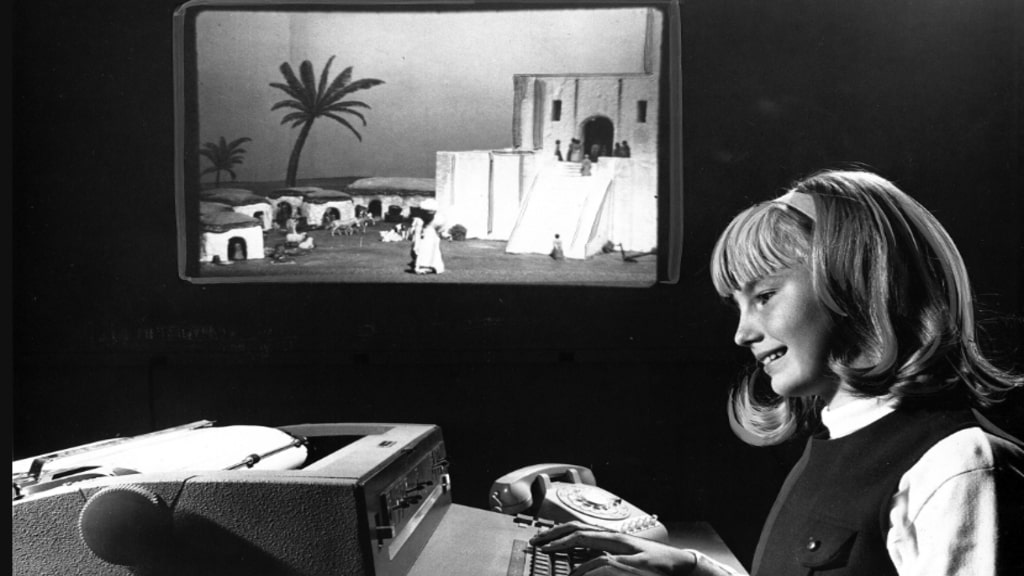
Promotional image for The Sumerian Game featuring a student trying the game out.
The game was the first of its kind, but it wasn’t just the idea of simulating choices and learning that made it extraordinary, it was also the story. Addis’ contribution was the design and writing of the game with dramatic characters, various detailed scenarios, a time mechanic, and a clear sense of action and consequence. As Arcadology’s YouTube video points out, she didn’t simply write some dull economic simulation game. She wrote an intricately written game about how decisions impact society in realistic and educational ways. There were narrative arcs, dialogue trees, and real-time consequences.
In 1966, The Sumerian Game experienced what you could call the first ever game patch when Addis, after observing her own students to see where they lost interest during play, revised and rewrote major sections of the game to reduce repetition, improve the overall flow, and add even more mixed media elements. This process of playtesting and patching is a common occurance in game development today, but at the time it was a revolutionary idea. While the original code for the game is thought to be forever lost in the ether, thanks to saved documents, old printouts, and copies of the original reports, the game has been recreated as a PC game on Steam.
As much as it pains me to admit, Addis’ contribution to gaming can be easily overlooked since the game wasn’t widely available or even known outside of an educational or research setting, but that doesn’t mean her contributions didn’t matter. One of the most powerful things I’ve realized through my experience playing, researching, and writing about video games, is that representation isn’t just about the character you see on your screen, it’s about the forgotten pioneers behind the scenes. A Critical Hit! calls The Sumerian Game “the most important video game you’ve never heard of,” and I think that’s so true. Once you begin to understand the game structure and narrative design that Addis created, you can see her ideas in countless modern games. I would even say that understanding her work opens up the opportunity for an even deeper conversation about what counts as a game, and how we define game design and innovation.
Mable Addis passed away in 2004, and during her life she received no acclaim, recognition, or award for her groundbreaking work. Truly, I doubt she ever realized that she personally laid the foundation for what would become one of the biggest sources of entertainment and education today. However, in 2023, the Game Developers Choice Awards posthumously awarded her with the Pioneer Award, which honors breakthrough and revolutionary game and tech design.
There’s something bittersweet and even poetic about the fact that Mable Addis, a simple history buff with a passion for teaching, made history herself by helping to create a whole new kind of storytelling and entertainment industry. Today, games are plentiful, with over 3.32 billion active players worldwide. Gamers get swept up in the next biggest triple-A game release and expensive cinematic trailers. They argue over endings, obsess over game lore, and form whole communities around certain franchises and narratives. But, beneath all of that are game design, mechanics, and narrative structure pioneered by Mable Addis, the first game storyteller, and arguably the mother of modern gaming narrative.